

Discover key language trends in the United States and how multilingual communication can improve understanding and engagement.
Across the country, millions of people are using a language other than English in their everyday lives, meaning that for organizations communicating with wide audiences it’s worth asking, how effectively are messages reaching people in the languages they are most comfortable using?
According to the U.S. Census Bureau’s American Community Survey, more than one in five people (22%) aged five and older speak a language other than English at home.
This statistic alone represents just how common multilingual communication needs are in the United States, and that language choice plays a significant part in audience engagement.
In this blog, we’ll explore foreign language trends across the United States, highlight the most spoken and fastest growing languages, and look at why multilingual communication is so important for improving understanding, accessibility and audience experiences.
What Are the Most Common Languages in the US?
Firstly, it might not come as a surprise that Spanish remains the most widely spoken non-English language in the U.S.
In 2024, an estimated 45 million people spoke Spanish at home, making it by far the largest language group after English. By comparison, Chinese was spoken by approximately 3.7 million people.
While Spanish clearly leads, these numbers also indicate that the U.S. is home to many language communities, each representing millions of people who engage with information most comfortably in a language other than English.
Now, let’s take a look at the top languages most frequently spoken at home among individuals aged five and older in the United States (Migration Policy Institute, 2025):
- Spanish – approximately 43 million speakers
- Chinese – approximately 3.5 million speakers
- Tagalog – approximately 1.8 million speakers
- Vietnamese – approximately 1.6 million speakers
Navigating Complex Information in a Second Language
Nationally, more than 8% of the U.S. population has Limited English Proficiency (LEP), meaning they speak English less than “very well.”
Therefore, even among individuals who speak English confidently, complex or specialized information can be difficult to fully take in with a second language.
Clear communication becomes especially important when content includes technical terms, detailed explanations, or high-stakes decisions (always considering situations where misunderstanding can easily occur).
That’s why providing information in multiple languages can help reduce uncertainty, improve comprehension and create more inclusive communication experiences.
Organizations can:
- Reach and effectively communicate with customers across different states where language needs vary significantly
- Ensure important information is clearly understood by all audiences, not just those fully comfortable reading in English
- Remove any limitations in engagement, participation or confidence in decision making
The Fastest Growing Languages in the United States
In addition to long-established language groups, research suggests that several non-English languages have seen strong growth in recent years.
Data collected by the U.S. Census Bureau between 2018 and 2023, shows that the following languages are growing the most:
- Spanish continued to grow at scale, with most of the U.S. Hispanic population living in California, Texas, and Florida.
- Portuguese increased by approximately 275,000 speakers
- Arabic exceeded 1.4 million speakers in the US, growing by around 165,000 speakers in recent years (Pew Research Center, 2023).
- Ukrainian has also risen significantly, reached an estimated 485,000 speakers in 2023
Languages such as Telugu, along with Bengali and Tamil, have also experienced plenty of growth too, and these shifts reflect changing communication needs and point to emerging language priorities beyond the most supported languages.
Let’s look at Omni Intercommunications’ home state, Texas for example:
Texas is home to nearly 3 million Spanish-speaking LEP residents, which is one of the largest totals in the nation. In addition, populations speaking Vietnamese (115,640), Chinese (71,139), Korean (30,852), Arabic (22,002), Urdu (18,041), Tagalog (17,982) and Hindi (12,656). (Limited English Proficiency (LEP) populations)
It’s important for us to note that the state-level language data referenced represents a sample rather than an exhaustive count. Even so, the volumes observed clearly demonstrate the scale of LEP populations and the ongoing need for regionally informed multilingual communication.
How Multilingual Communication Improves Understanding and Engagement
Together, these trends show that multilingual communication is both an accessibility consideration and a way to ensure that your audience fully understands what they are signing up for and feels confident in their choices.
Data and industry experience consistently show that consumers are more likely to engage with, trust and act on information presented in the language they are most comfortable reading.
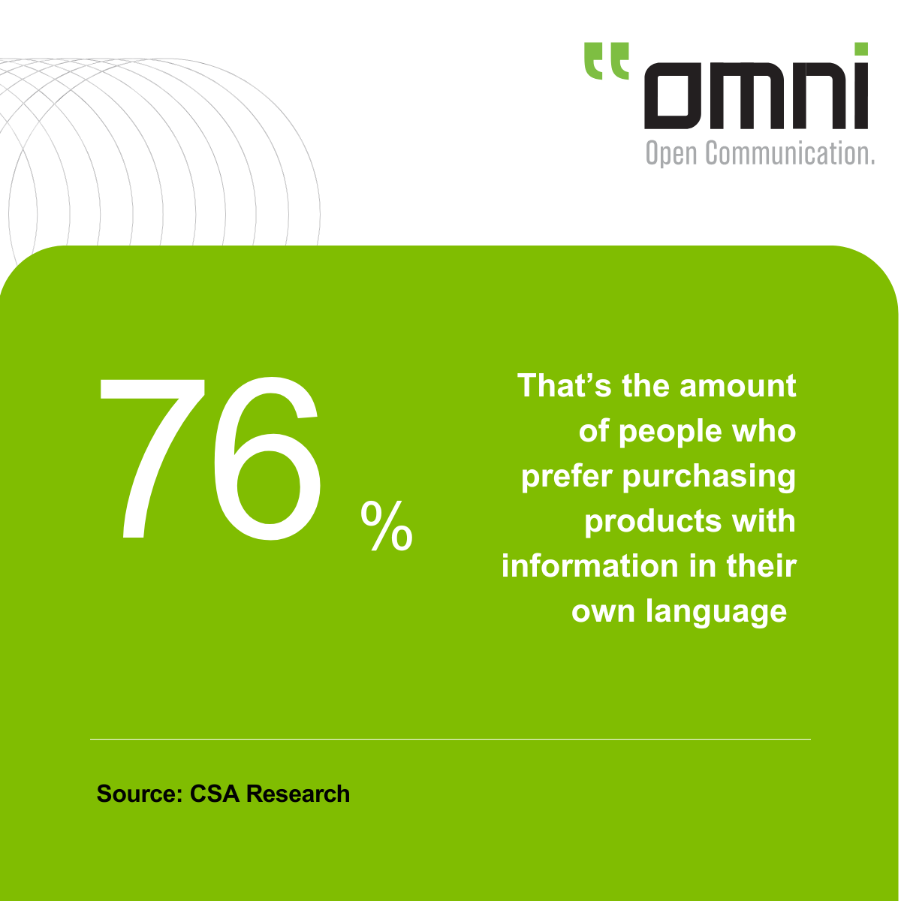
Research shows that 76% of people prefer purchasing products with information in their native language. Additionally, 40% will never buy from websites in other languages (CSA Research, 2020).
While every organization’s approach will differ, the data clearly points to a growing need for language communication strategies across the United States.
When people receive information in a language they’re most comfortable using, messages are clearer, details are easier to process and there is far less room for misinterpretation (especially when content includes unfamiliar terminology).
Multilingual communication also supports stronger engagement since audiences are more likely to read, trust and act on information that feels accessible and relevant to them.
To learn more about how Omni can support your multilingual communication needs, contact us today.