If your staff can’t fully understand your educational and learning materials, then that may present risks that can be costly.
It’s wisest to mitigate those risks is to ensure that your staff can comprehend the eLearning materials so they can apply them.
We have supported eLearning projects for decades now. When we say decades, we mean it. Omni has been supporting the industry since we were founded in Texas, Houston, in 1978.
In this blog, Omni multimedia writer Jack Heale will take a detailed look at what multimedia services lie within eLearning. Additionally, he will explore why these services work so well within the eLearning industry.
What kind of multimedia services can support your eLearning content?
- Voice overs
- Subtitles
- Subtitle translation
- Transcription
- American Sign Language
Voice overs
Voice overs (VOs) provide clear, engaging narration to make learning accessible to all.
Another interesting thing to consider is the workflow: whether you opt for human or AI.
Back in 2009, there was preliminary research on the Voice Principle, which stated: “people learn better when narration is spoken in a human voice rather than in a machine voice.”
More than a decade on, would that still stand up?
Well, it does in Mayer’s Multimedia Principles for learning in 2020, where he said: “people learn better when the narration in multimedia lessons is spoken in a friendly human voice rather than a machine voice.”
It’s important to note that over the last couple of years, the AI-generated voice has gotten stronger and stronger to the point where some voices (unless labelled) may not be spotted as AI VOs.
However, the point still stands that people learn better with a friendly, human voice, and if a mispronunciation occurs, it will outline the machine voice.
Subtitles
Whether you opt for open or closed captions, subtitling services are commonly used for eLearning materials.
- Open captions: Captions that are burnt-in to the screen. They can’t be turned off.
- Closed captions: An overlay on the screen that can be turned on or off.
More than half (51%) of U.S. audiences watch content with subtitles most of the time, a survey by Preply in 2023 found.
Whether it’s for internal or external learning resources, subtitles have a role to play.
Subtitle translation
Of course, you may have non-native speakers in your workforce, so if you’re providing subtitles, consider subtitle translation to ensure that staff can get the most out of the eLearning content.
As a subtitling company, we translate and localize subtitles in over 220 language pairs. Some of our most requested languages include:
- American English
- Spanish
- LatAm Spanish
- British English
Transcription
In case you need to revisit what has been said in a voiceover or a presentation, transcription services convert your speech to text to reaffirm the learnings.
American Sign Language (ASL)
Consider American Sign Language interpreting services if you have ASL users in your workforce. More than 500,000 are thought to use ASL in the U.S. as their native language, according to the Commission on the Deaf and Hard of Hearing.
Omni can supply pre-recorded ASL for your eLearning projects, as opposed to on-site interpreting.
Why does multimedia suit eLearning?
There are three key reasons as to why multimedia support and eLearning go hand in hand:
- Comprehension, attention and memory
- Engagement
- Improve workplace safety and compliance
Comprehension, attention and memory
There are several studies that show captions improve memory, comprehension, and attention.
Video captions, also known as same-language subtitles, benefit everyone who watches videos (children, adolescents, college students, and adults). More than 100 empirical studies document that captioning a video improves comprehension of, attention to, and memory for the video.
The study also notes that captions are beneficial for non-native audience members, people learning to read, and deaf and hard of hearing audiences.
As for voice overs, Mayer’s Modality Principle proposes that, when graphics are being used, learners generally learn more effectively from spoken narration than from equivalent on-screen text.
Both points are in line with our experience at Omni.
Engagement
If you have put time and dedication into the creation of your eLearning content, it is wise to maximize engagement to get the best return on investment (ROI).
Services like subtitles, sign language interpreting and voice overs can increase engagement rates by making content easier to consume, wherever you are.
“When trying to engage a wider audience with your eLearning content, we always recommend that teams target audiences backed up by reliable market research. Being Texas-based ourselves, we would always recommend for other Texas businesses wanting to better target their staff to explore Spanish content, provided there is there is the audience data to back it up.”
Anthony Montoya, Multimedia Production Manager
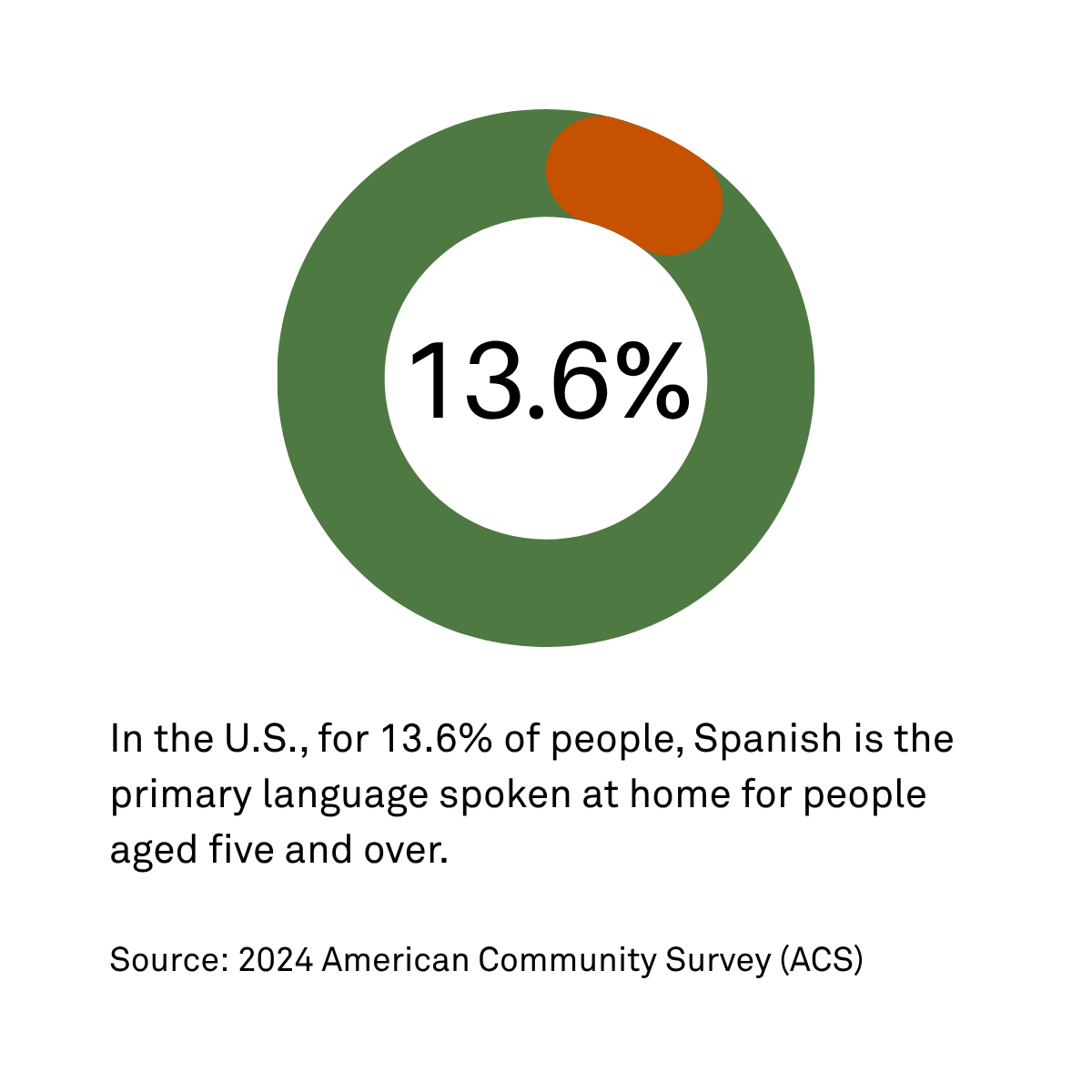
In 2024, an estimated 45 million people in the U.S. spoke Spanish at home, making Spanish by far the most widely spoken non-English language in the country. Most of the U.S. Hispanic population are living in California, Texas, and Florida.
As for Texas specifically, there are almost three million Spanish-speaking Limited English Proficient (LEP) residents.
There is no doubt that there is a huge market here to be tapped into. The aforementioned multimedia services cater to both local and domestic workforces.
Improve workplace safety and compliance
eLearning platforms are often used to deliver training programs, this may be for:
- Health and safety
- Compliance requirements
- Onboarding
- Workplace conduct
Rather concerningly, half (50%) of non-native English speakers say that their company doesn’t offer training in their native language, according to a report by Vector Solutions.
Training for non-native English speakers, when provided in a secondary language, could increase risks.
For example, more than 17 million Spanish speakers in the U.S. speak English less than “very well”. Health and safety and compliance materials can contain complicated phrasing and technical terminology that may be difficult for some to interpret accurately.
Given that, in 2023, the total cost of work injuries was $176.5 billion, according to the National Safety Council, it may be wise to ensure your workplace can understand the materials as best as possible.
If you place yourself in the shoes of a non-native speaker, the mental load of processing information in a second language is not easy. Then, they must take in the information accurately and apply it as well.
That’s why multimedia support is so important.
Conclusion
Having read the blog, you should be better placed to assess whether you need multimedia services for eLearning projects.
Key takeaways
- Multimedia services like voice overs, subtitles, subtitle translation, transcription and American Sign Language all support eLearning.
- These services can strengthen comprehension, attention, memory, engagement, and improve workplace safety and compliance.
To explore multimedia services for your eLearning project, contact the Omni team today.